
A bronze plain bearing bushing is one of the simplest parts in a machine — and one of the most frequently replaced. As long as a catalogue size fits, it is easy. Trouble starts when the housing has an odd diameter, the shaft is already worn, a flange or grease groove is needed, and the machine builder stopped supplying spares years ago. Then the bushing has to be made to drawing. In this article we describe what needs to be settled on that drawing so the bushing lasts as long as it should.
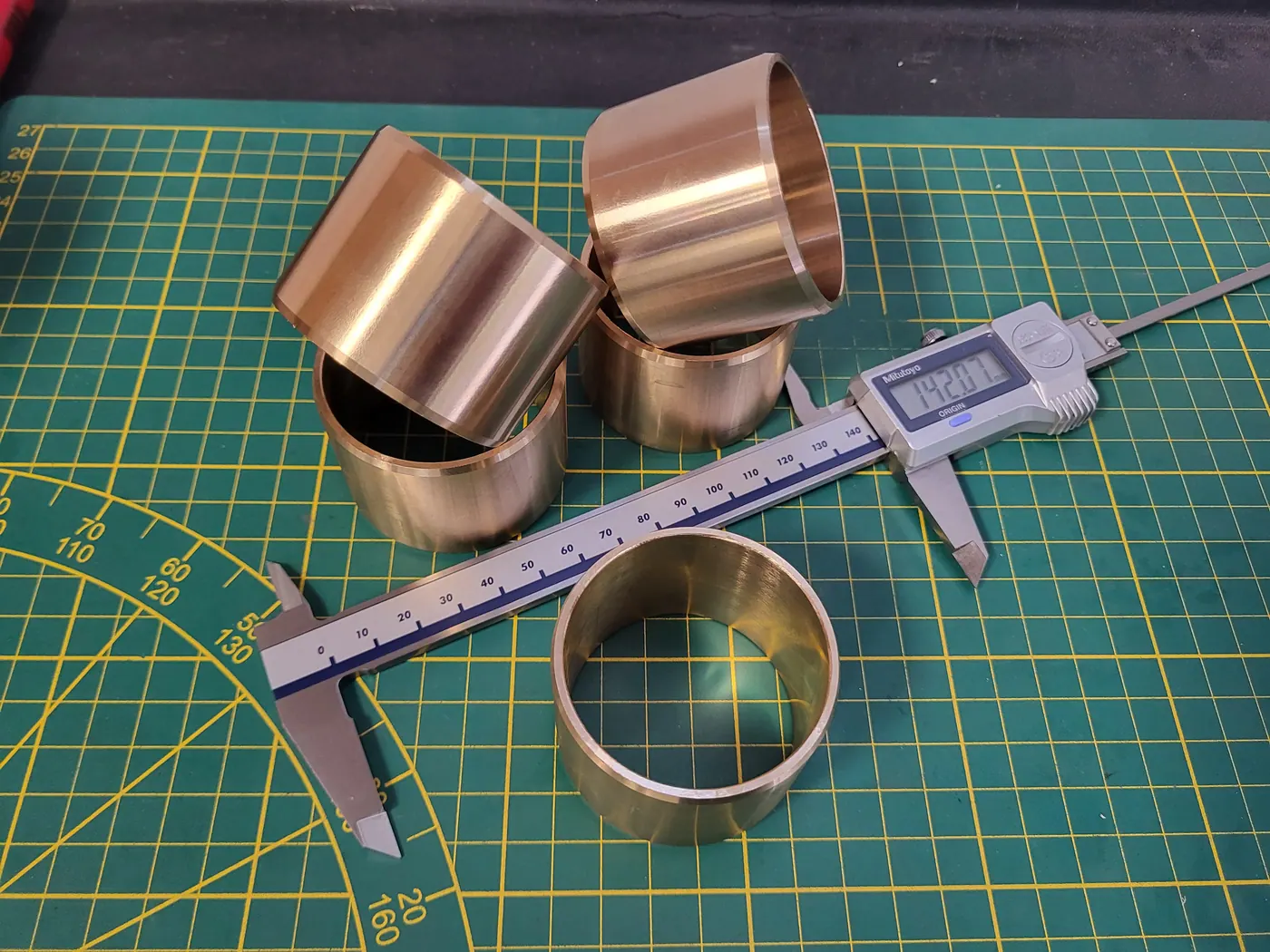
When a catalogue bushing will not do
Bronze bushings are available as finished catalogue parts and as tube stock for machining. A bushing made to drawing makes sense when:
- the dimensions are non-standard — outside diameter, bore or length do not appear in the standard range,
- the bushing has features — a flange, assembly chamfers, undercuts, slots,
- lubrication grooves or oil holes are needed in a specific position,
- a particular bronze alloy is required that the catalogue does not offer,
- a worn bushing must be reproduced in an older machine — often with the bore matched to a shaft that is itself worn.
That last case is part of a wider topic: making spare parts for machines and deciding whether to regenerate or remake a part.
Bronze alloys at a glance
The alloy is the designer's call, but it helps to know the main groups, as they differ in properties and price:
| Alloy (example) | Common name | Typical use |
|---|---|---|
| Tin bronze CuSn10P | phosphor bronze | high loads, low speeds, good wear resistance |
| Leaded gunmetal CuSn7Zn4Pb7 | Rg7 (DIN) | general-purpose bushings, moderate loads, easy to machine |
| Aluminium bronze CuAl10Fe5Ni5 | nickel aluminium bronze | high loads and shock, corrosive environments |
If the drawing does not specify an alloy and the bushing replaces a worn original, the safest starting point is the original material — or an analysis of the operating conditions: load, sliding speed, lubrication and shaft material.
Fits and bore closure after pressing in
This is the most common source of problems with bushings made "by eye". A bushing is usually pressed into its housing with interference. The interference compresses the wall, and part of that deformation carries through to the bore — after pressing in, the bore is smaller than before assembly. With a thin wall and a large interference, the difference can eat up the entire planned clearance.
The bushing drawing should therefore clearly state:
- the outside-diameter fit to the housing — tolerances of bushing and housing, e.g. housing H7,
- the bore dimension, noting whether it applies before or after pressing in,
- the running clearance to the shaft — based on speed, temperature and lubrication,
- for tight clearances — finishing the bore after assembly, e.g. reaming or boring in the housing.
How tolerances translate into cost is covered in our article on tolerances in CNC machining.
Lubrication: grooves, oil holes and self-lubricating bushings
A plain bearing bushing performs only as well as it is lubricated. The drawing should define:
- lubrication grooves — axial, circumferential or spiral; their position should follow the load direction, because a groove in the highest-pressure zone weakens the oil film,
- the oil hole — aligned with the grease nipple in the housing,
- chamfers and radii on the bore edges, which ease shaft assembly and do not scrape off lubricant.
Where regular lubrication is not possible, self-lubricating bushings are used — with graphite plugs or sintered. That, however, is a separate, mostly catalogue product group.
One-offs and series
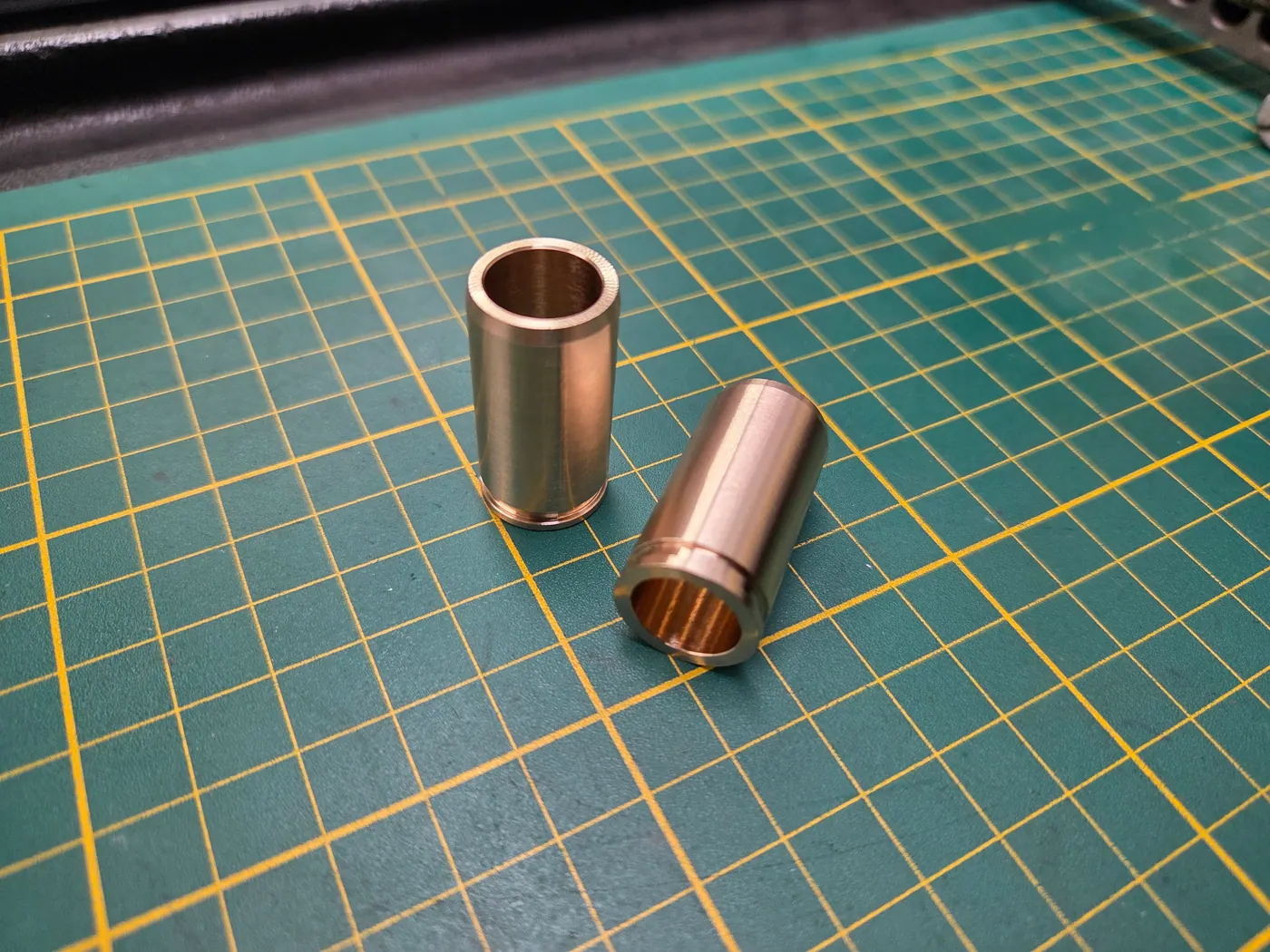
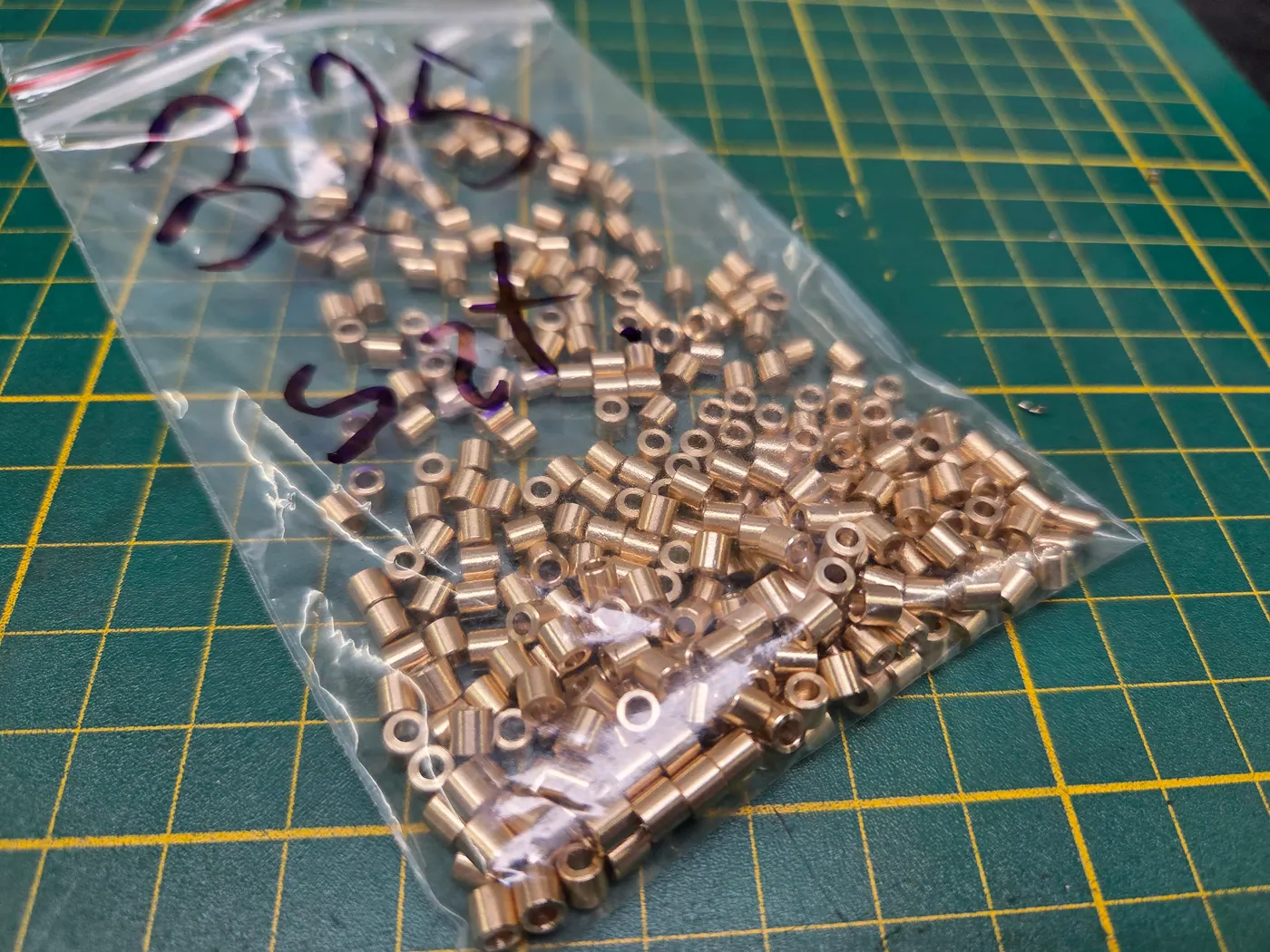
We make bronze bushings both ways. Single bushings are mostly spare parts for maintenance — what matters is a quick match to the existing housing and shaft. Series are bushings fitted into manufactured products and must be identical batch after batch. Above is a batch of 325 bushings labelled with the quantity; below, a series being measured with a micrometer.
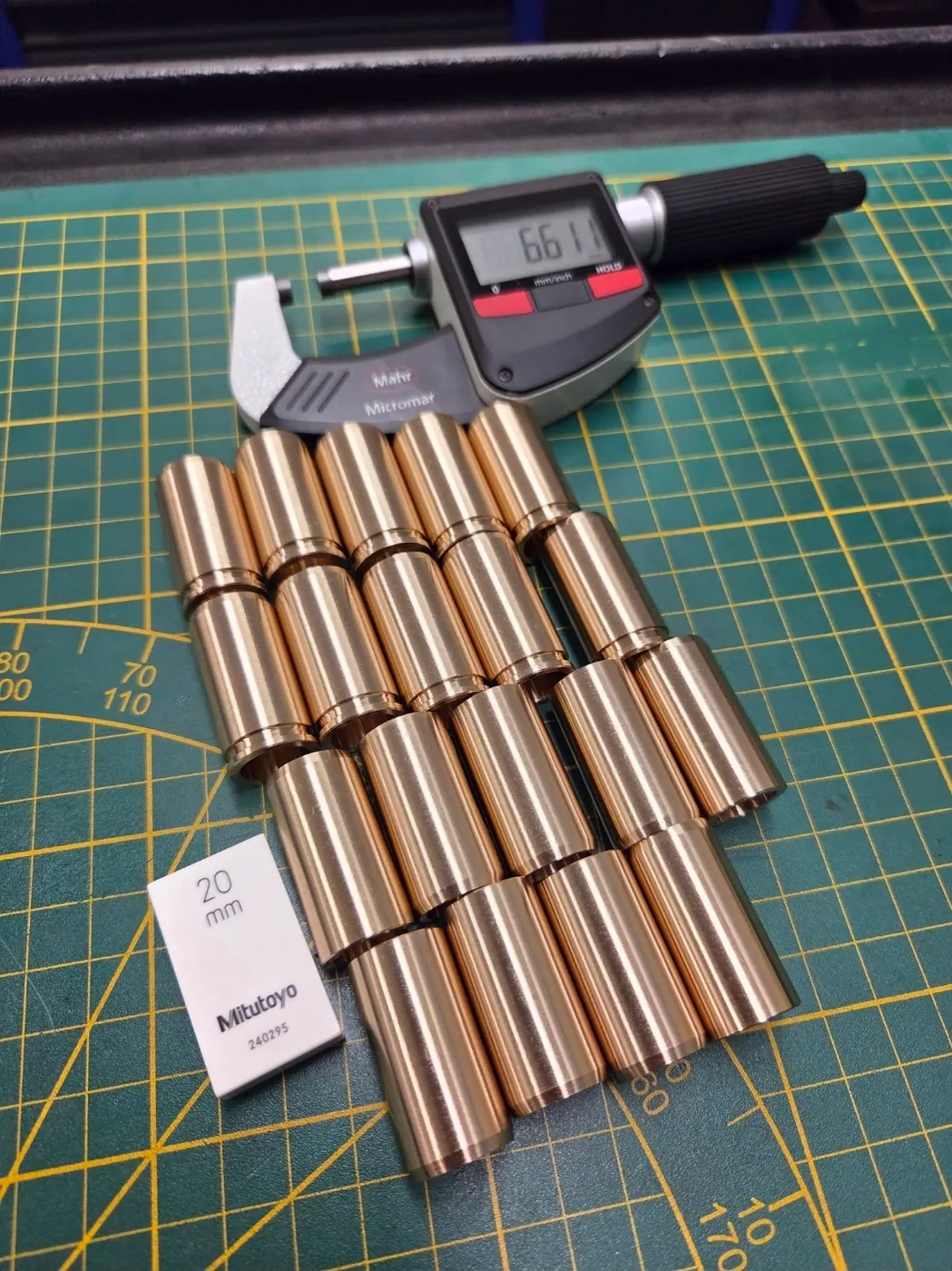
On CNC lathes we turn parts up to Ø 350 mm and 2500 mm long, which covers most plain bearing bushings — from bushings a few millimetres across to well over 100 mm in diameter. How we run series is described in our article on CNC turned parts in series.
What to send for a quote
- the drawing with dimensions, tolerances and bore surface finish — or, for a spare part, the housing and shaft dimensions or a sample of the worn bushing,
- the bronze alloy, or the operating conditions we should select it from,
- assembly details — interference, and whether the bore dimension applies before or after pressing in,
- lubrication grooves and oil holes, if needed,
- the quantity — one-off, batch or repeat series.
Summary
A bronze bushing made to drawing makes sense when the catalogue does not fit the housing, the shaft or the operating conditions. Its service life depends on the alloy, a correctly specified fit that allows for bore closure, and well-thought-out lubrication. We turn bushings singly and in series on CNC lathes — send your drawing or dimensions and within 48 hours we will come back with a quote and any questions about the fit.
FAQ
Which bronze alloy should I choose for a plain bearing bushing?
For high loads and low speeds, tin bronze such as CuSn10P works well. For general-purpose bushings under moderate loads, leaded gunmetal such as CuSn7Zn4Pb7 (Rg7) is a common choice. Aluminium bronze such as CuAl10Fe5Ni5 is used for high loads, shock and corrosive environments. The final choice should come from the machine designer's calculations or experience.
Why does the bore get smaller after pressing in?
The interference on the outside diameter compresses the bushing wall, and part of that deformation carries through to the bore. The drawing must therefore state whether the bore dimension applies before or after assembly, and for tight running clearances allow for finishing the bore after pressing in.
Do you make single bushings for older machines?
Yes. Reproducing a worn bushing for a machine that no longer has spare parts available is a typical job. A drawing is best; if there is none, send a sample or the housing and shaft dimensions and we will agree the sizes together.
What sizes can you make?
On CNC lathes we turn parts up to Ø 350 mm and 2500 mm long, which covers the vast majority of plain bearing bushings. We make both small bushings in series of several hundred pieces and bushings well over 100 mm in diameter.
Can the bushing have lubrication grooves?
Yes. Lubrication grooves — axial, circumferential or spiral — and oil holes are made to drawing. Their shape and position should follow the load direction and the way lubricant is supplied.
Related topics
CNC turned parts in series — what we turn, which materials and how we measure
Bushings, spacers, pins, stepped shafts and threaded parts — an overview of the turned parts we produce in series, with materials, measurement and photos from our shop floor.
Read the articleCustom machine parts — how to order a replacement when there is no documentation
Three scenarios for having machine parts made: with a drawing, from a worn sample and with nothing at all. How measurement and reverse engineering work, and what to watch with fits.
Read the articleReconditioning or making a new part — which pays off more?
Weld overlay and grind, or make from scratch? We compare reconditioning and a new part by cost, time, risk and repeatability — including the trap of repeated reconditioning.
Read the article